

Secure the Base
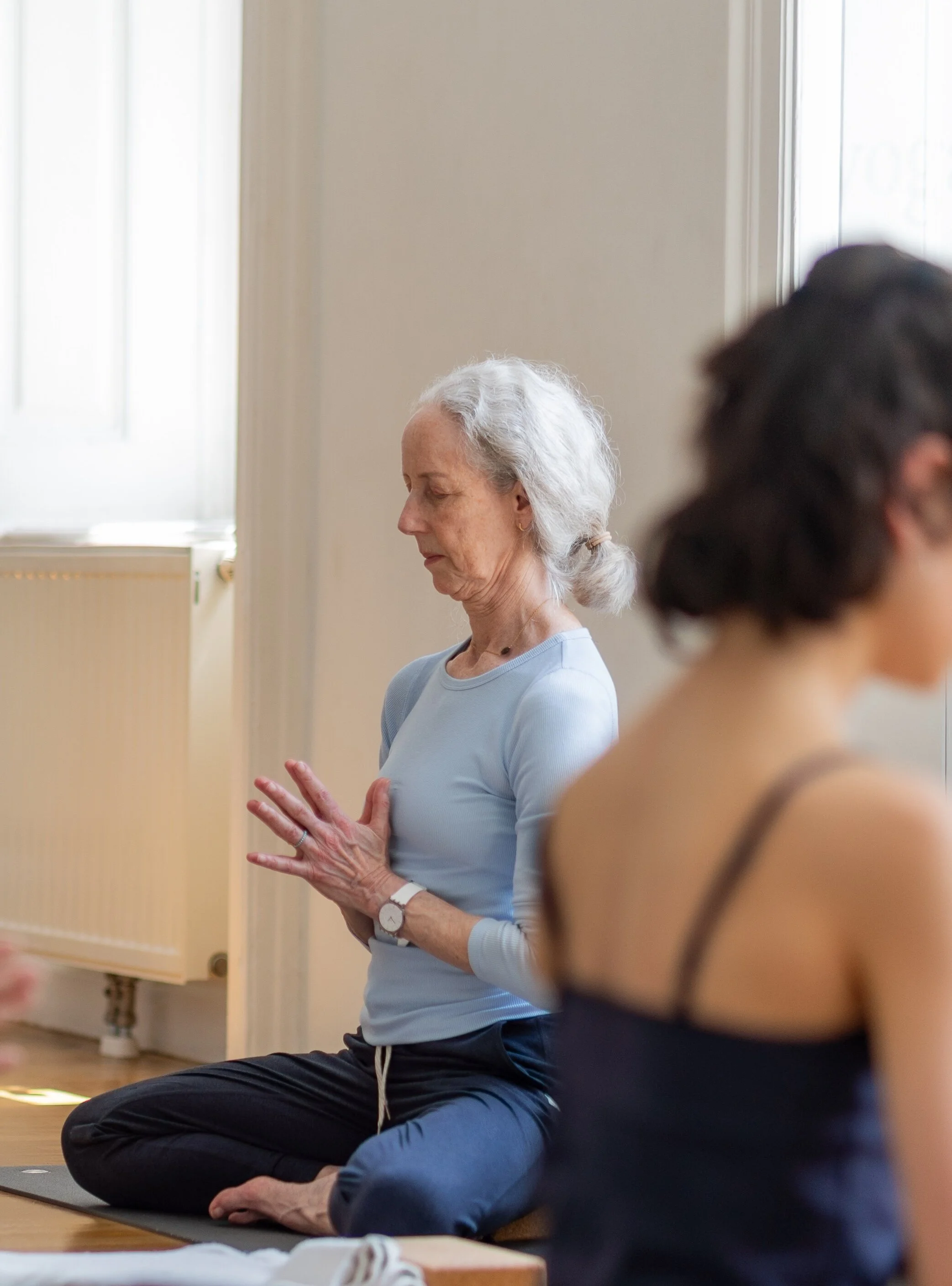
The true depth in Yoga practice asks each of us to consider “Who am I?”
- Annie Carpenter
I was thinking for a name for an Asana practice I led yesterday that brings awareness to the joint where the Sacrum and Lumbar 5 (bottom vertebra in the lower back) meet, and I came to this: Secure the Base. My goal was to awaken our unconscious habits in this area so that we can do our poses, and live our lives with a happy sacrum and lower back.
In early years of Asana practice, we seek fairly extreme openings in most joints in the body. As we age however, things change. For longevity's sake, it's best to seek, instead, stability and strength and give up flexibility – but not mobility. Like all things, Asana exists on a continuum:
… Strength > < Stability > < Mobility > < Flexibility …
What is not apparent much of the time is that at the extremes on either end of this continuum is the possibility of injury. Too much flexibility, or extreme strength on one side of a joint, leads to joint instability, and typically excessive motion in one direction. Over time this pattern can take us into joint osteo-arthritis, and/or other painful situations.
The important and missing piece is awareness. Why aren't we aware of these imbalances which we are creating? This is the negative side of even the best-intentioned habit: we become unconscious. In even our most loved habits we can avoid full awareness, and we love our Asanas! And most of us have some poses that we especially love because we have a sensation of opening – a stretch that makes us feel good, that makes us feel alive.
Whether this is an active opening like Urdhva Mukha Dhanurasana (Upward Facing Bow or Wheel pose), or a passive stretch like Eka Pada Rajakapotasana (single pigeon stretch), many of us love—crave even—these poses. In both cases, if these poses are pushed to the extreme we can slowly over-extend joints, here typically low back and hip, creating pain and potentially long-term problems.
As a teacher, it is easy to focus on our students who can take poses deeply. We can pass this obsession on to our students: there is an unspoken gospel that deeper is better, in many Yoga rooms. The missing inquiry here is What does Deeper mean?
True depth in Yoga practice asks each of us to consider "Who am I?" In early years, we consider that question in relation to the physical body: "I have tight hips," or "I have a big backbend." The teacher's guiding light should, I feel, shine on each student's deepening inquiry: Not on bigger, "deeper" poses, but on deepening INNER awareness, so the question "Who am I?" leads to one's true Self.
But we are doing Asana, you say. Yes, Asana is a physical practice and it is meant to point us inward. In today's world of extreme sitting, Asana can bring balance, steadiness and ease to the body so that we can go DEEPER INWARD. We can live our everyday lives with more ease and energy when the body is balanced, which gives us time and space to consider life's deeper questions.
Asana is not an end in itself. It is a wonderful and fun way to stay healthy and deepen awareness. It is a path for living in like-minded community, and for dwelling in our ever-changing bodies with patience and compassion. It is a place where habits can be honed to slowly help us create a life of depth, truth and love.